Block Movement Drill: 7v7 Game
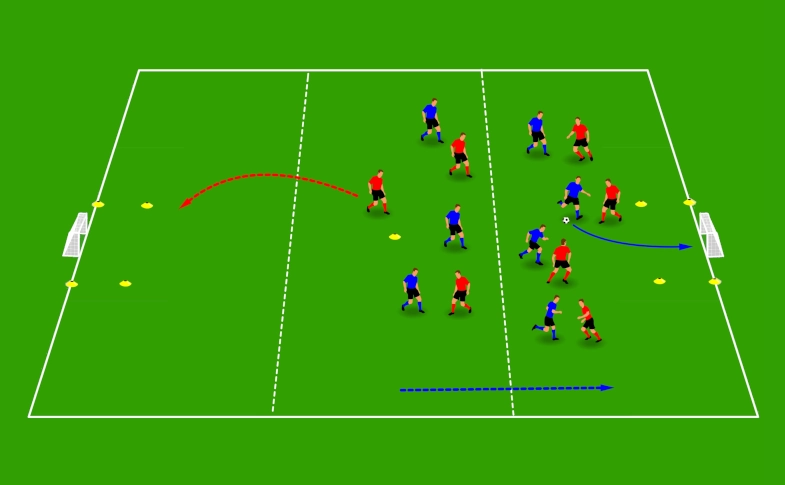
This block movement drill uses a simple 7v7 small-sided game to train players to move up the pitch together, stay connected between lines, and react quickly when possession changes. It is ideal for adult amateur teams because it turns team compactness into a clear match condition: if the team stays stretched, the goal will not count.
Setup
Use a half pitch with the full width of the field. Divide the playing area into three horizontal zones: defensive third, middle third, and attacking third. If you are using an existing pitch, the natural markings can help you set the area quickly. If no marked field is available, use cones to create the outer pitch and the two zone lines.
Place one small goal at each end. In front of each small goal, mark a small no-player box with four cones. The box should be around 2–3 metres deep and slightly wider than the goal. This prevents players from standing directly in front of the small goal and blocking it like a goalkeeper.
Set up two teams of seven. There are no goalkeepers. Each team attacks one small goal and defends the other.
Equipment Needed
- 3 or more balls
- 16 cones
- 2 sets of training vests
- 2 small goals
Rules & Instructions
Play the game as a normal 7v7 match, with zone rules that encourage both teams to move as a connected block.
- Start each round from the middle, like a normal game.
- Play 7v7 towards small goals, with no goalkeepers.
- Split the pitch into defensive, middle, and attacking thirds.
- Goals count only if no teammate stays in the defensive third.
- The team in possession must squeeze out of its defensive third before finishing.
- The middle third is offside-free.
- Normal offside rules apply in the attacking third.
- When the defending team wins the ball, they counter-attack immediately.
- Mark a small no-player box in front of each small goal using four cones.
- No player may stand or defend inside the no-player box.
- Restart from the middle after a goal.
- Use throw-ins when the ball goes out on the side.
- If the ball goes behind the goal, restart with a pass from the goal line.
- If a goal is invalid, restart with an indirect free kick from where the shot was taken.
- Play 5-minute rounds.
- Each round counts as one game. Play best of five games.
- Rotate substitutes between rounds only if extra players are waiting.
Coaching Tips
- Encourage the team in possession to squeeze up together instead of leaving two or three players behind the play.
- Coach the nearest players to support the ball while the far-side players shift across and stay connected.
- Use the defensive third rule to show players when the team is too stretched.
- Remind players that compactness is not about everyone chasing the ball. It is about keeping useful distances between teammates.
- Stop players from camping near the small goals. The no-player box keeps the drill focused on team shape, not goal-line blocking.
- On turnovers, look for quick reactions. The team that has pushed up must recover, delay the counter-attack, and protect central space.
- If the game becomes too open, pause briefly and ask the team where the gaps are appearing.
- Praise teams that move across the pitch together before pressing, rather than pressing in disconnected ones and twos.
Why It Works for Adult Amateur Teams
Adult amateur teams often understand the idea of staying compact, but they struggle to apply it once the game becomes stretched. This block movement drill makes the problem visible. If players stay too deep, their team cannot score. If they all rush forward without balance, they become vulnerable to the counter-attack.
The three-zone layout makes team shape easy to see. Coaches can quickly identify whether the team is connected, whether the back players have stepped up, and whether the midfield area is protected. The offside-free middle third also creates a realistic risk-reward decision: players can stay higher for the counter, but the opposition can punish poor recovery.
Because the game is 7v7, it feels close enough to a real match for players to make natural decisions. At the same time, the rules are simple enough for a Sunday league training session. The best-of-five format adds competitiveness while keeping the total workload manageable.
Key Outcomes:
- Move forward and across the pitch together.
- Keep the team connected between lines.
- Recover quickly after losing the ball.
- Attack and defend as one compact unit.
- Reward timing, support, and communication.
Related Posts
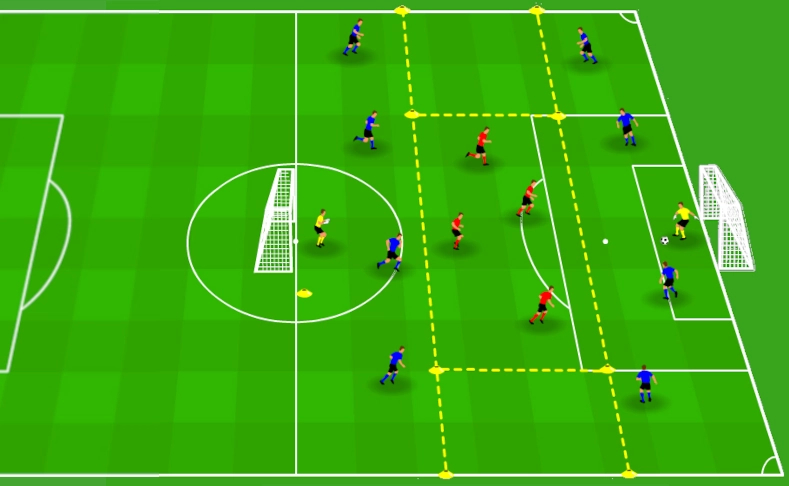
Back Four Exit - Defenders vs Midfield and Attack
A Back Four Exit drill for adult amateur teams, training build-up play, pressing, switching play, transitions, and finishing in a zoned half-pitch setup.
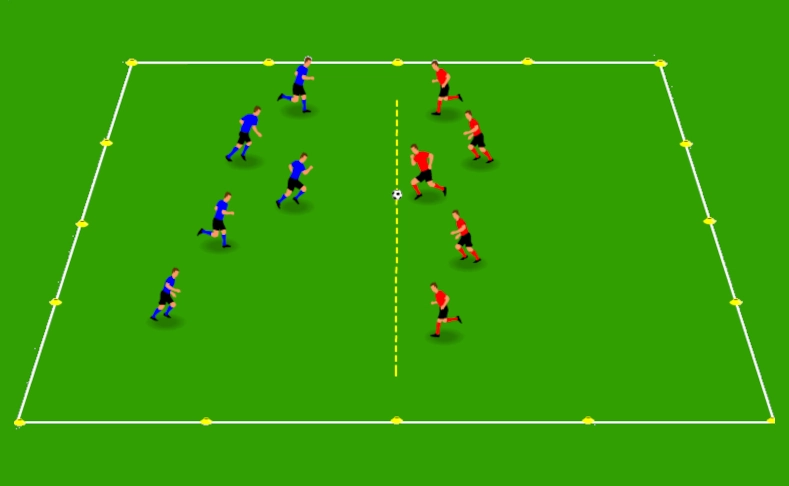
Spatial Awareness Drill: Football with Rugby Rules
Sharpen spacing, patience, and communication by playing football with rugby’s offside rule and a goal-line carry finish.
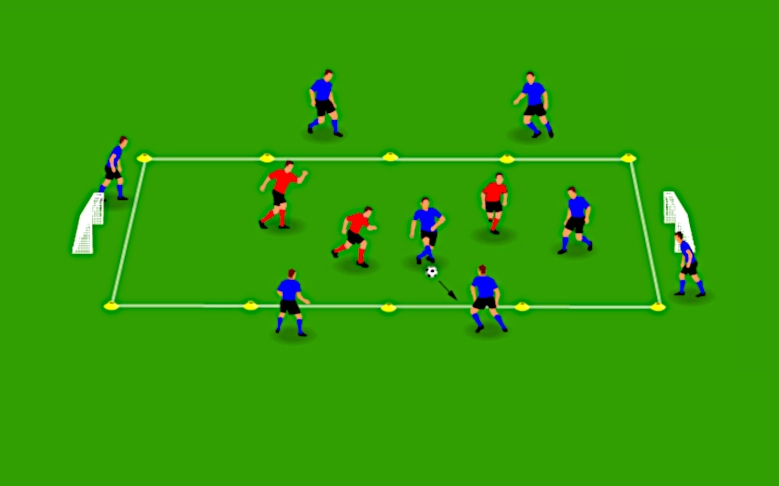
8v3 Ajax Football Rondo Drill with Mini Goals
Football rondo drill for adult amateurs: 8v3 Ajax game to sharpen passing, pressing, and decision-making with quick restarts.